

Roughly 90% of paved driveways in the United States are asphalt — and at some point, every one of them needs attention. The question most Louisville homeowners face isn’t whether to fix a failing driveway, but how: do you resurface what’s there, or tear it out and start over? Getting that call wrong can cost thousands of dollars and leave you with a driveway that fails again in just a few years. This guide breaks down the asphalt overlay vs. full replacement decision in plain terms so you can walk into any estimate conversation knowing exactly what questions to ask.
Key Takeaways
- An asphalt overlay (resurfacing) lays 1.5–2 inches of fresh hot-mix asphalt over your existing driveway — faster and typically 40–50% less expensive than full replacement.
- Full replacement removes the old pavement down to the gravel base, repairs or rebuilds that base, and installs entirely new asphalt — the right call when the foundation has failed.
- The condition of the sub-base, not just the surface, is the deciding factor between the two options.
- Louisville’s freeze-thaw winters accelerate base failure, meaning what looks like a surface problem is sometimes a structural one.
- Widespread alligator cracking, soft spots, or standing water almost always point toward full replacement.
- Minor to moderate surface cracking with a solid base is the sweet spot where an overlay delivers real value.
- Every driveway is different — an on-site evaluation is the only reliable way to make the right call.
What Is an Asphalt Overlay, and When Does It Make Sense?
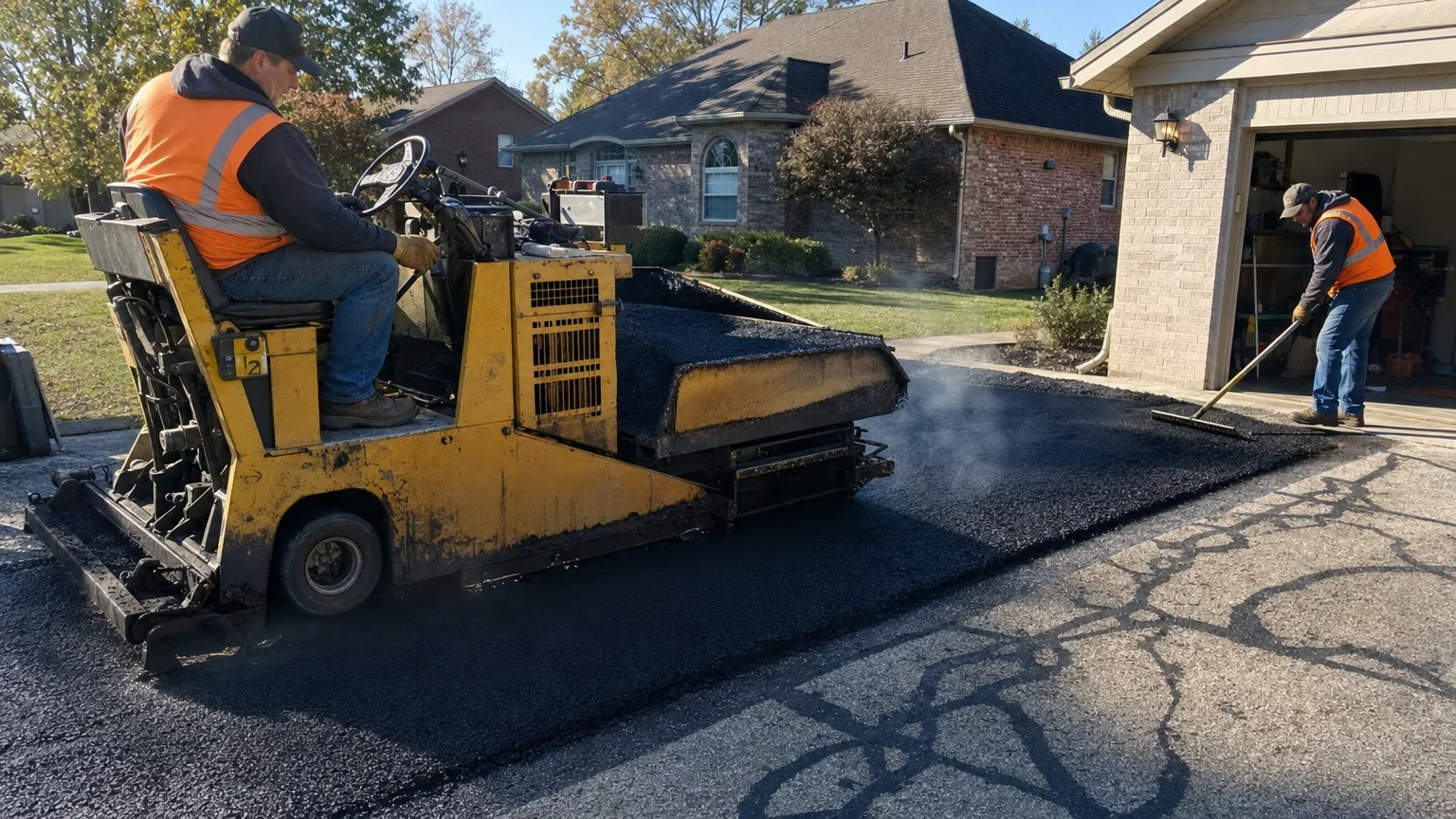
An asphalt overlay — sometimes called resurfacing — means laying a fresh layer of hot-mix asphalt directly on top of your existing driveway after cleaning, repairing cracks, and ensuring the surface is ready to bond. The new layer is typically 1.5 to 2 inches thick and, when done correctly, gives the driveway a clean, smooth appearance and adds years of functional life.
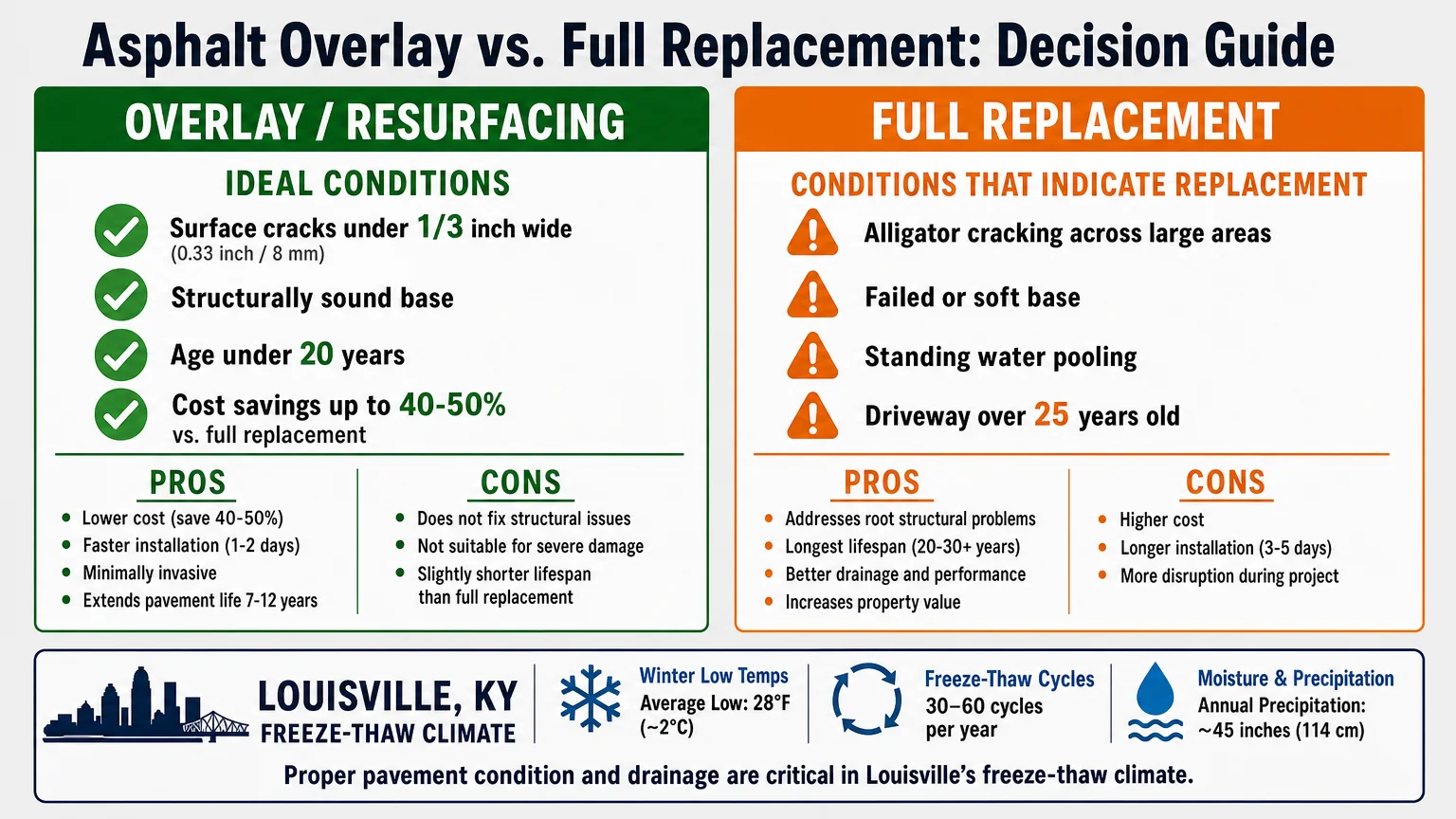
Overlays work best when the underlying base is still structurally sound. Think of it like refinishing hardwood floors: if the wood itself is solid, refinishing makes perfect sense. If the subfloor is rotted, no amount of surface work will hold. The same logic applies to asphalt. Good candidates for an overlay include driveways with:
- Surface-level cracking that hasn’t spread into a web-like alligator pattern across large areas
- Minor raveling or weathering where the top layer has oxidized and lost flexibility
- A driveway under roughly 20 years old with no history of base problems
- No significant drainage issues — water should sheet off the surface, not pool
If your driveway fits this profile, an asphalt overlay and resurfacing can be a smart, cost-effective solution that extends the life of your pavement without the disruption of a full tear-out.
What Does Full Replacement Actually Involve?
Full replacement means exactly what it sounds like: the existing asphalt is removed with heavy equipment, hauled away, and the project starts from the ground up. That includes grading and compacting the gravel base (and sometimes adding new base material), then installing fresh asphalt in one or more compacted lifts.
It’s more labor-intensive, takes longer, and costs more — but it’s the only option that actually fixes a failed foundation. If you skip full replacement when the base has failed and just overlay instead, the new surface will reflect the same cracks and soft spots within a season or two. You’d be spending money twice.
Full replacement is typically the right path when you’re dealing with:
- Alligator cracking (that interconnected web pattern covering large sections of the driveway)
- Soft or spongy spots where the pavement flexes under foot or vehicle weight
- Standing water that doesn’t drain — a sign of base settlement or grading failure
- A driveway over 25 years old that has been patched repeatedly
- Root intrusion or severe frost heave that has shifted the base material
For Louisville homeowners, freeze-thaw cycles are a major culprit here. Water infiltrates surface cracks, freezes, expands, and forces the pavement apart from below. Over several winters, this can turn a manageable surface problem into a compromised base — which is why proper drainage and site prep matter so much from the start. Learn more about how we approach asphalt driveway paving with Louisville’s climate in mind.
How Do You Tell Which One Your Driveway Actually Needs?
The honest answer is that a visual inspection from the street won’t give you a definitive answer — you need someone to walk the driveway, probe for soft spots, and evaluate the drainage patterns. That said, here are the clearest signals pointing each direction.
Signs an Overlay Is Likely Sufficient
- Cracking is present but cracks are isolated, not interconnected
- The surface feels firm and stable underfoot and under vehicle weight
- Water runs off the driveway rather than pooling in low spots
- The driveway is less than 20 years old and hasn’t been overlaid before
- Damage is mostly cosmetic — fading, minor raveling, small cracks
Signs Full Replacement Is Probably Necessary
- Alligator cracking covers more than roughly one-third of the surface
- You can feel the pavement flex or sink when you walk or drive over it
- Water consistently pools in the same spots after rain
- The driveway has already been overlaid once and is failing again
- Edges are crumbling and base material is visible
How Do the Costs Compare Between Overlay and Full Replacement?
Cost is almost always the first question homeowners ask, and it’s a fair one. As a general rule, an asphalt overlay costs significantly less than full replacement — often in the range of 40–50% less — because you’re skipping the demolition, haul-away, and base rebuild steps.
However, pricing for any paving project in Louisville depends on several real variables:
| Factor | How It Affects Cost |
|---|---|
| Driveway size (square footage) | Larger area = higher total cost for either option |
| Current surface condition | More prep work needed = higher cost |
| Base condition (for replacement) | Base repairs add cost to full replacement |
| Asphalt depth required | Thicker lifts cost more in material |
| Site access and grading | Difficult access or re-grading adds labor |
Because every property is different, we provide on-site estimates rather than flat rates. That way you know exactly what’s included before any work begins — no surprises once the crew shows up. If you’re ready to get a clear picture of what your driveway needs, contact us to schedule a free estimate.
Does an Overlay Last as Long as Full Replacement?
Not quite, but that doesn’t make it a bad investment. A well-installed asphalt overlay on a sound base can realistically add 10–15 years of life to a driveway. A full replacement, with proper base prep and drainage, can last 20–30 years or more before needing major attention.
The key phrase in both cases is “proper installation.” An overlay done without adequate crack repair and surface prep will fail early. A replacement done without addressing drainage or base compaction will also fail early. The quality of the work — particularly site preparation — matters more than which option you choose.
For more detail on how asphalt repair in Louisville fits into the bigger picture of driveway maintenance, our repair page covers the range of options between minor patching and full resurfacing.
What About Commercial Properties — Same Rules Apply?
Largely yes, though the scale and stakes are different. A parking lot serving customers or employees has higher traffic loads, which means base failure shows up faster and costs more to ignore. The same overlay-vs.-replacement logic applies: if the base is sound, resurfacing is a cost-effective option. If it’s compromised, a full replacement is the better long-term investment.
Commercial property owners and managers in Louisville can find more information on our parking lot paving and resurfacing in Louisville page, which covers both new installation and resurfacing for commercial surfaces.
Making the Right Call for Your Louisville Driveway
The asphalt overlay vs. full replacement decision comes down to one thing: the condition of the base under your pavement. Surface problems on a solid foundation are fixable with resurfacing. Structural problems need a structural solution. Trying to cut costs by overlaying a driveway that needs replacement is one of the most common — and expensive — mistakes homeowners make.
If you’re in Louisville or the surrounding Jefferson County area and your driveway is showing signs of wear, the best next step is a straightforward on-site estimate. We’ll evaluate the surface, check for base issues, and give you an honest recommendation along with a clear price — so you can make a confident decision without guessing. Reach out to our team to get started.
Frequently Asked Questions
How thick is a typical asphalt overlay?
Most residential overlays are 1.5 to 2 inches of compacted hot-mix asphalt. That's enough to cover surface imperfections, restore smoothness, and add meaningful structural depth — as long as the base beneath it is still stable.
Can you overlay a driveway that has already been overlaid once?
Sometimes, but it depends on the total thickness of existing asphalt and the condition of the base. Multiple overlays can raise the driveway surface to the point where it conflicts with garage thresholds or drainage grades. A professional evaluation will tell you if a second overlay is practical or if replacement is the better path.
How long does an asphalt overlay take to complete?
Most residential driveways can be overlaid in a single day. The driveway is typically ready for foot traffic within a few hours and vehicle traffic within 24 hours, though waiting 48–72 hours before parking heavy vehicles is a good practice.
Will an overlay fix potholes?
Potholes need to be properly patched and filled before an overlay is applied — you can't simply pave over them. If the pothole is a symptom of base failure rather than just surface deterioration, an overlay won't solve the underlying problem. Visit our [asphalt repair](/services/asphalt-repair/) page for more on pothole repair options.
Does Louisville's weather affect which option I should choose?
Yes, meaningfully. The freeze-thaw cycles Louisville experiences each winter are hard on asphalt, especially any water that has worked its way into cracks or the base. If your driveway has been taking on water for multiple winters, the base damage may be more extensive than the surface suggests — another reason an in-person evaluation matters.
How do I know if my base is still good?
The clearest signs of a compromised base are soft or spongy spots under vehicle weight, standing water that doesn't drain, and alligator cracking across large areas. A paving contractor can probe the surface and assess drainage patterns during an on-site estimate to give you a definitive answer.
Is it worth repairing an old driveway, or should I just replace it?
If the driveway is over 25 years old and showing widespread structural failure, replacement usually makes more financial sense than repeated repairs or an overlay. If it's younger and the damage is mostly cosmetic, repair or resurfacing can extend its life significantly at a lower cost.
Contributing writer at Paving Company Louisville KY.
