

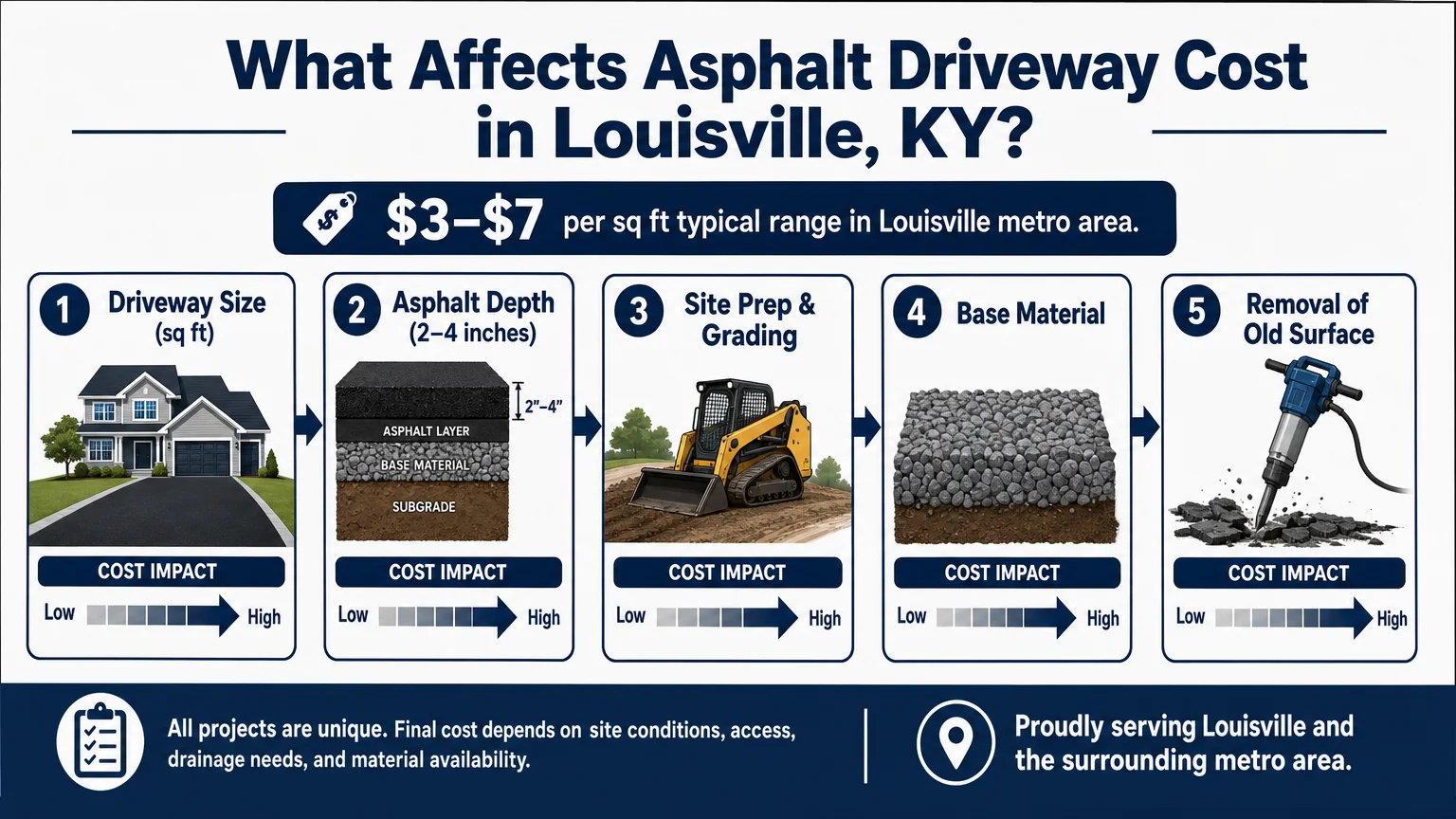
A standard residential asphalt driveway in the Louisville metro area typically runs between $3 and $7 per square foot, though the final number depends on several site-specific variables that no flat-rate estimate can capture. Understanding what drives that range — and what separates a durable installation from one that needs repairs within a few seasons — is exactly what this guide covers.
Quick Answer
For most Louisville homeowners, a new asphalt driveway costs between $3,000 and $10,000+, depending on size, site conditions, and the depth of asphalt required. Smaller, straightforward driveways land closer to the lower end; larger projects with significant grading, base work, or old surface removal push costs higher. Every property is different, which is why on-site estimates are the only reliable way to get an accurate number.
Key Takeaways
- Asphalt driveway pricing in Louisville is typically quoted per square foot, with most residential jobs falling between $3–$7/sq ft.
- Size, depth, and site prep are the three biggest cost drivers — not just the asphalt material itself.
- Louisville’s freeze-thaw winters require proper base preparation and drainage to prevent early cracking and heaving.
- Removing an existing driveway (concrete or old asphalt) adds cost but is sometimes necessary for a quality result.
- Getting an on-site estimate — rather than a phone quote — is the only way to price a job accurately.
- Asphalt generally costs less upfront than concrete, though both require ongoing maintenance.
- A properly installed asphalt driveway can last 20–30 years with routine sealing and minor repairs.
- Cheaper bids often skip base prep or use thinner asphalt lifts — shortcuts that cost more in repairs down the road.
What Does a New Asphalt Driveway Cost in Louisville, KY? Breaking Down the Price Range
The honest answer is: it varies. A 400-square-foot single-car driveway on a flat lot with no existing surface to remove is a very different project than a 1,200-square-foot double-wide with a steep grade, poor drainage, and a cracked concrete apron to demolish. Both are “new asphalt driveways,” but the costs are miles apart.
Here’s a general framework for how Louisville-area pricing typically breaks down:
| Driveway Size | Estimated Cost Range |
|---|---|
| Small (300–500 sq ft) | $900 – $3,500 |
| Medium (600–900 sq ft) | $2,400 – $6,300 |
| Large (1,000–1,500 sq ft) | $4,000 – $10,500+ |
These figures reflect installed cost — materials, labor, and standard site prep. They do not include demolition of an existing surface, significant regrading, or drainage corrections, which are priced separately based on what the site actually requires.
What Factors Have the Biggest Impact on Driveway Paving Cost?
Several variables move the needle more than most homeowners expect. Understanding them helps you evaluate bids accurately and avoid being surprised once work begins.
1. Square footage The single largest driver. More surface area means more asphalt, more labor, and more base material. Measure your driveway carefully — length × width — before requesting estimates.
2. Asphalt thickness Residential driveways typically use 2–3 inches of compacted asphalt over a prepared base. High-traffic areas or driveways used by heavy vehicles may require 3–4 inches. Thicker lifts cost more but significantly extend pavement life.
3. Base preparation and grading This is where Louisville’s climate makes a real difference. Freeze-thaw cycles — cold winters followed by warm springs — cause ground movement that can crack and heave poorly prepared pavement within a season or two. A proper crushed stone base, correct grading for drainage, and adequate compaction are non-negotiable for long-term performance. Skipping or rushing this step is the most common reason driveways fail early.
4. Removal of existing surface If you have an old concrete or asphalt driveway, it typically needs to be demolished and hauled away before new asphalt is installed. Demo and disposal costs vary depending on thickness, material, and accessibility.
5. Drainage corrections Low spots, poor slope, or areas where water pools require grading corrections before paving. Ignoring drainage is one of the fastest ways to shorten pavement life in Louisville’s wet climate.
6. Accessibility and site conditions Narrow lots, steep grades, limited equipment access, or landscaping near the work area can add labor time and cost.
For a full overview of what the installation process involves, visit our asphalt driveway paving service page.
How Does Asphalt Compare to Concrete for a Louisville Driveway?
Asphalt and concrete are the two most common driveway materials in Jefferson County. Here’s how they compare on the factors that matter most to homeowners:
| Factor | Asphalt | Concrete |
|---|---|---|
| Upfront cost | Lower ($3–$7/sq ft) | Higher ($6–$12/sq ft typical) |
| Installation time | 1–3 days + cure time | Longer cure period |
| Performance in freeze-thaw | Flexible — handles movement better | Can crack under ground movement |
| Maintenance | Requires sealing every 3–5 years | Lower routine maintenance |
| Repairability | Easy to patch and resurface | Harder to repair invisibly |
| Lifespan | 20–30 years with maintenance | 30–40 years with maintenance |
| Appearance | Classic black; can be sealcoated | More color/finish options |
For most Louisville homeowners, asphalt offers a practical combination of lower upfront cost, easier repairability, and better flexibility in freeze-thaw conditions. Concrete has its place — particularly for decorative applications — but asphalt remains the dominant choice for residential driveways in this region for good reason.
What Does a New Asphalt Driveway Cost Compared to Resurfacing an Existing One?
If your existing driveway is structurally sound but showing surface wear — fading, minor cracking, or a rough texture — resurfacing (also called an overlay) is often a cost-effective alternative to full replacement. An asphalt overlay applies a new layer of asphalt over the existing surface, restoring appearance and extending life at a fraction of full-replacement cost.
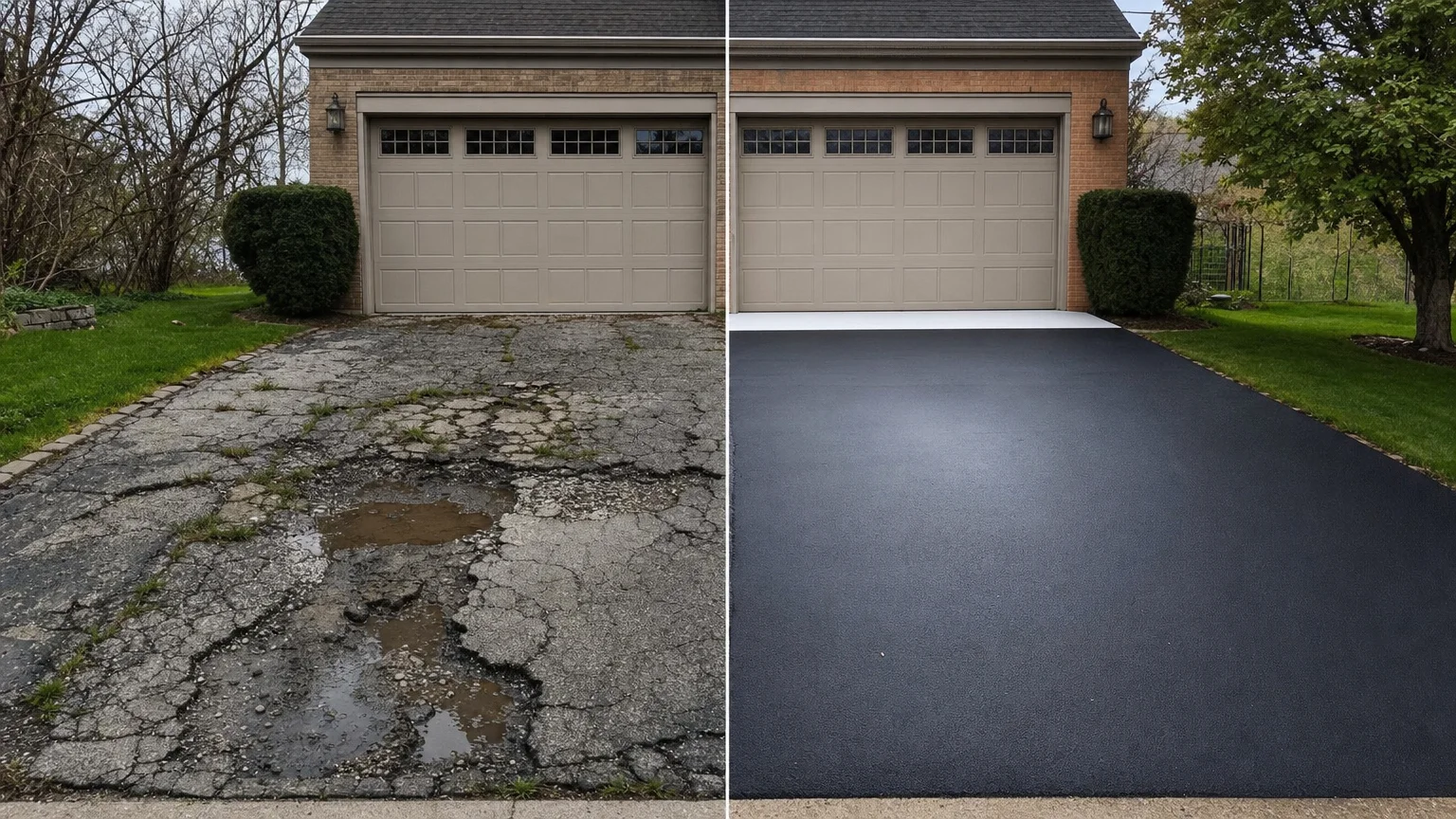
The key distinction: resurfacing works when the base and existing asphalt are still structurally intact. If there’s significant cracking, heaving, or base failure, an overlay won’t fix the underlying problem — it will just delay it. A proper assessment determines which approach is appropriate.
Learn more about when resurfacing makes sense on our asphalt overlay and resurfacing page. And if your driveway has specific damage that needs attention before any new paving, our asphalt repair in Louisville service covers those situations as well.
Why Do Asphalt Bids Vary So Much Between Contractors?
It’s not unusual for homeowners to receive bids that differ by 30–50% for what seems like the same job. The reasons usually come down to a few key differences:
- Base preparation depth — A lower bid may include minimal base work. A higher bid may include proper excavation, gravel base, and compaction. These aren’t equivalent jobs.
- Asphalt thickness — Some contractors spec 1.5 inches; others spec 3 inches. The difference in material cost is significant, and so is the difference in longevity.
- Mix quality — Asphalt mix specifications vary. Higher-quality mixes with appropriate aggregate size and binder content perform better in Louisville’s temperature extremes.
- Drainage and grading work — Some bids include grading corrections; others assume the existing grade is fine even when it isn’t.
- Overhead and warranty — Established contractors carry proper insurance, stand behind their work, and price accordingly.
When comparing bids, ask each contractor specifically what base depth they’re including, what asphalt thickness they’re specifying, and whether drainage corrections are included. Those questions reveal a lot.
What Should I Expect During the Estimate Process?
Reputable paving contractors in Louisville provide on-site estimates rather than phone quotes — and for good reason. The actual condition of your soil, the existing surface, the grade of your lot, and drainage patterns all affect scope and cost in ways that can’t be assessed remotely.
During an on-site visit, a contractor should:
- Measure the area accurately
- Assess the existing surface and base condition
- Evaluate drainage and grading needs
- Discuss asphalt thickness appropriate for your use case
- Provide a written estimate that itemizes what’s included
There should be no pressure to sign on the spot, and the estimate should clearly explain what’s included so there are no surprises once work begins. If you’re ready to get a number for your project, contact us to schedule an on-site estimate.
Getting an Accurate Number for Your Project
Asphalt driveway pricing in Louisville isn’t one-size-fits-all — and any contractor who quotes a firm number without seeing your property is guessing. The variables that matter most (base condition, drainage, site access, and the scope of prep work required) can only be assessed in person.
If you’re weighing your options, our FAQ page covers additional questions homeowners commonly ask before starting a paving project. For commercial properties or parking lot work, our commercial paving in Louisville page covers those services separately.
When you’re ready to move forward, reach out to schedule an on-site estimate. You’ll get a clear, itemized number based on your actual property — and a straightforward explanation of what the work involves before anything begins.
Frequently Asked Questions
How long does a new asphalt driveway last in Louisville?
A properly installed asphalt driveway in Louisville typically lasts 20–30 years with routine maintenance, including sealcoating every 3–5 years and prompt repair of any cracks or damage. Louisville's freeze-thaw winters accelerate wear on surfaces that weren't properly prepared, so base work and drainage are critical to reaching that lifespan.
How soon can I use my driveway after it's paved?
Most asphalt driveways can handle foot traffic within 24 hours and vehicle traffic within 2–3 days, though full curing takes longer. Avoid parking heavy vehicles or turning sharply on new asphalt during the first few weeks, especially in hot weather when the surface is softer.
Does asphalt need to be sealed after installation?
New asphalt should not be sealed immediately — it needs time to cure and off-gas. Most contractors recommend waiting 6–12 months before the first sealcoat application. After that, sealing every 3–5 years protects the surface from UV damage, water infiltration, and oxidation.
What's the difference between asphalt paving and asphalt resurfacing?
Full paving involves preparing the base and installing new asphalt from the ground up. Resurfacing (overlay) applies a new asphalt layer over an existing surface that is structurally sound. Resurfacing costs less but is only appropriate when the base and existing pavement are in good condition.
Can I get an asphalt driveway in winter in Louisville?
Asphalt installation requires ground temperatures above approximately 50°F and dry conditions for proper compaction and adhesion. In Louisville, this generally means paving season runs from spring through fall. Winter installations are possible during mild stretches but are not ideal for quality results.
Why does my asphalt driveway crack in winter?
Louisville's freeze-thaw cycles cause the ground beneath pavement to expand and contract repeatedly. When water infiltrates small surface cracks, freezes, and expands, it widens those cracks from the inside. Proper base preparation, adequate asphalt thickness, and prompt crack sealing are the best defenses against this cycle.
Do I need a permit to pave a driveway in Louisville?
Permit requirements vary by municipality and project scope. In many cases, residential driveway paving does not require a permit, but work that affects the street connection or drainage may. Your contractor should be familiar with local requirements and advise you accordingly.
Contributing writer at Paving Company Louisville KY.
